 Renew Before It Lapses
Protect
What happens to your domain if your registrar closes
Last reviewed
The short version
- A registrar works under a contract with ICANN. ICANN can end that contract for set reasons.
- Registrars must keep a safety copy of their domain data with ICANN or an escrow agent.
- If a registrar's contract ends, that copy can be released so ICANN can keep services going for a short time.
- Privacy-protected owners are covered by that copy too.
Why a registrar might stop
Your registrar is a company that is accredited by ICANN. That means ICANN has signed a contract with it, called the Registrar Accreditation Agreement. If you want to know what a registrar does, see what you own.
ICANN can end that contract early. The agreement lists the reasons.[1] Some are serious, such as a court finding of fraud. Others are plainer. One is failing to fix a breach of the agreement within 21 days of ICANN's notice.[1] Another is a step like handing control of the business to its creditors.[1]
A registrar can also simply stop trading. This page only covers what the agreement says. It doesn't say how every closure plays out.
The safety copy
Think of a registrar as a filing cabinet with your domain's details in it. What if the cabinet vanishes?
The agreement answers that with a data escrow. An escrow is a safe place where a third party holds something. The registrar must send a copy of its registration data to ICANN, or to an escrow agent that ICANN approves.[1]
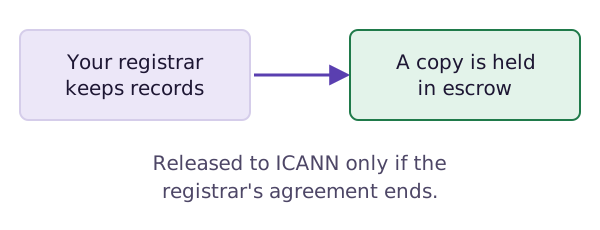
The copy isn't there to be browsed. It is held only to check it is complete. It is released if the agreement expires without renewal, or is terminated.[1]
When it is released, ICANN, or whoever it names, gets a licence to use it. The licence is for transitional purposes only, to provide registrar services.[1] So the aim is to keep names working while they move.
If you use privacy protection
A privacy service puts someone else's details in the public record in place of yours. You may worry that your real details are stuck with a closed company.
They aren't. The agreement says a registrar must include the contact details of privacy customers in its escrow deposits.[1] ICANN can open those details only if the agreement ends, or if the registrar ceases business.[1]
This covers privacy services run by the registrar or its affiliates. If a separate company gives you privacy, ask that company how it handles a closure. The agreement doesn't promise anything there.
What to do now
You can't stop a registrar failing. You can make life easier if it does.
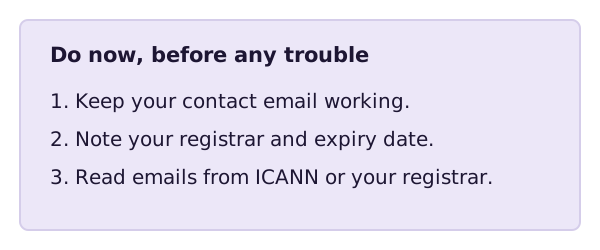
- Keep the email on your record working. Notices go there. The registrant page says why.
- Write down your registrar's name and your domain's expiry date. The renewing page shows what to track.
- Read mail from ICANN or your registrar. Don't ignore it.
- Check your lookup record now and then, so you know what it says.
If you'd rather not wait, you can move on your own terms. The transfer page walks through it. Doing it early, while the registrar still answers, is much easier.
Sources
- 2013 Registrar Accreditation Agreement, ICANN (accessed 2026-11-11)