 Renew Before It Lapses
Register
Whose name goes on the domain, and why it matters
Last reviewed
The short version
- The registrant is the name on the domain's record.
- That name carries the responsibility, gets the reminders and has the final say on a transfer.
- A business should be the registrant. Not a person who might leave.
- Keep the email and details up to date.
The registrant, in plain words
When you register a domain, you give your details. The person or group named there is the registrant. ICANN's policy calls this role the Registered Name Holder.[1]
The role isn't just a label. Three things follow it.
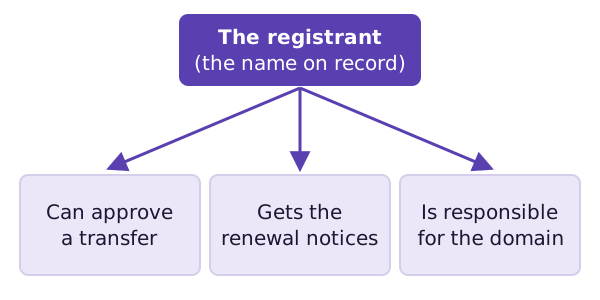
It carries the responsibility. The registrant takes sole responsibility for registering and using the name.[2]
It gets the reminders. Before a domain expires, the registrar has to tell the registered name holder at least two times.[3]
It has the final say on a transfer. Only two parties can approve or deny a move to another registrar. One is the registered name holder. The other is the administrative contact, a second contact on some records.[1] If they disagree, the registered name holder's word wins.[1]
Why a business should care
Picture a small business. A web designer sets up the domain and puts their own name and email on it. The business never looks at the record again.
Now follow the three jobs above. The reminders go to the designer. The designer can approve a transfer. The designer is the one who carries the responsibility. If the designer moves on, the business can't easily act on its own domain.
That's an example, not a real case. But it shows why the name on the record matters. It's the name that has the power.
So the safest choice is simple. Make the business, club or group the registrant. Use an email address the organisation controls, such as one on a shared mailbox, rather than one person's inbox.
Keep the record right
ICANN lists what a registrant must do. Here are the parts that apply to the record itself.
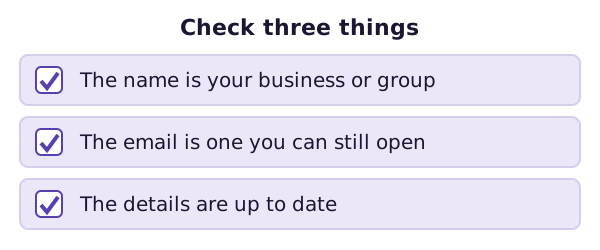
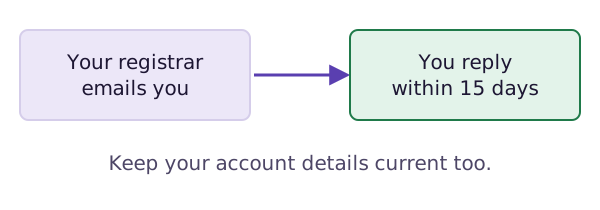
- Reply to your registrar within 15 days if it asks you something, and keep your account details up to date.[2]
- If you use auto-renew, keep your payment details up to date too.[2]
One more tip comes from ICANN. Registrars are told to suggest a second email address that isn't tied to the domain itself.[3] That makes sense. If the domain's own email stops when the domain expires, a reminder sent there would never arrive.
What next
With the record right, the next job is the calendar. The next page shows how renewal works and what reminders to expect.
Sources
- Transfer Policy, ICANN (accessed 2026-10-26)
- Registrants' Benefits and Responsibilities, ICANN (accessed 2026-10-26)
- Expired Registration Recovery Policy, ICANN (accessed 2026-10-26)