 Renew Before It Lapses
Protect
Domain name disputes and the UDRP process
Last reviewed
The short version
- The UDRP is ICANN's policy for settling some disputes over a domain name.
- A complainant must prove three things. All three.
- A panel can only cancel the name or transfer it. It can't award money.
- Courts stay open to both sides.
- This page is general information, not legal advice.
What the UDRP is
Sometimes another party says your domain name unfairly uses their trademark. A trademark is a name or mark a business uses to tell its goods or services apart. The UDRP is a set of rules for dealing with that kind of claim. Its full name is the Uniform Domain Name Dispute Resolution Policy.
When you register a domain, your registrar's agreement with you includes this policy. So you must take part if a third party, called the complainant, brings a claim under it.[1] A neutral panel hears the claim. The panel is the person or small group who decides it.
People often call the habit of registering a name that matches someone else's trademark cybersquatting. The UDRP is one way to challenge it. For the ordinary rules about who owns a domain, see what you own.
What the complainant must prove
The complainant has to show three things.[1]
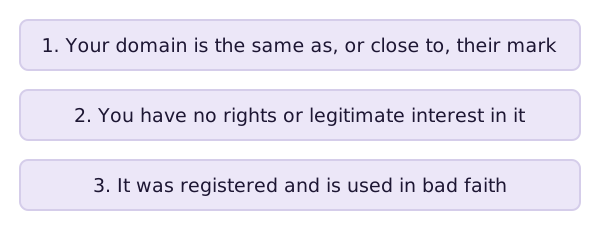
First, your domain is identical or confusingly similar to a trademark in which the complainant has rights.[1] Second, you have no rights or legitimate interests in the name.[1] Third, the name was registered and is being used in bad faith.[1]
The policy is plain that the complainant must prove that each of these three elements is present.[1] If one is missing, the claim fails.
What "bad faith" can look like
The policy gives examples. One is registering a name mainly to sell it to the trademark owner. Or to a competitor. The price must be above your documented costs.[1] The list isn't complete.
The policy also lists ways an owner can show a real interest in a name. One is being commonly known by the name, even with no trademark.[1] So a small business or club with a real name has some protection.
What a panel can order
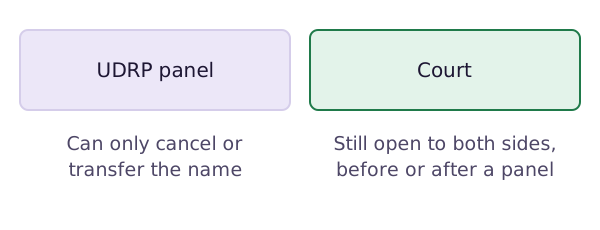
A panel has only two options. It can cancel the domain, or transfer it to the complainant.[1] It can't order anyone to pay damages under this policy.
Decisions are published in full online, apart from exceptional cases.[1]
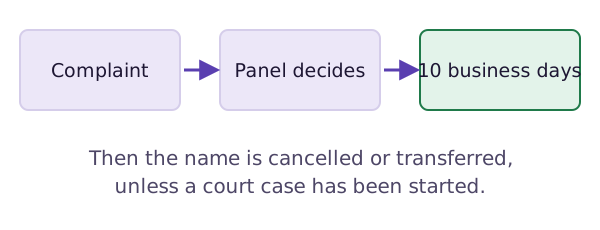
After a decision, your registrar waits ten business days before acting on it.[1]
Courts stay open
The UDRP doesn't replace a court. Either side can take the dispute to a court before a panel case starts, or after it ends.[1] Say a panel orders a cancel or transfer. You then start a lawsuit in the right place within those ten days, and send proof. The registrar holds off.[1]
What to do if you get a complaint
- Read every message. Don't ignore it.- Keep the email on your record working, so notices reach you. See the registrant page.
- Check the status words on your domain, so you know what is on it.
- Ask a qualified lawyer about your own case. Trademark law differs from country to country, and this page can't judge your situation.
Sources
- Uniform Domain Name Dispute Resolution Policy, ICANN (accessed 2026-11-13)